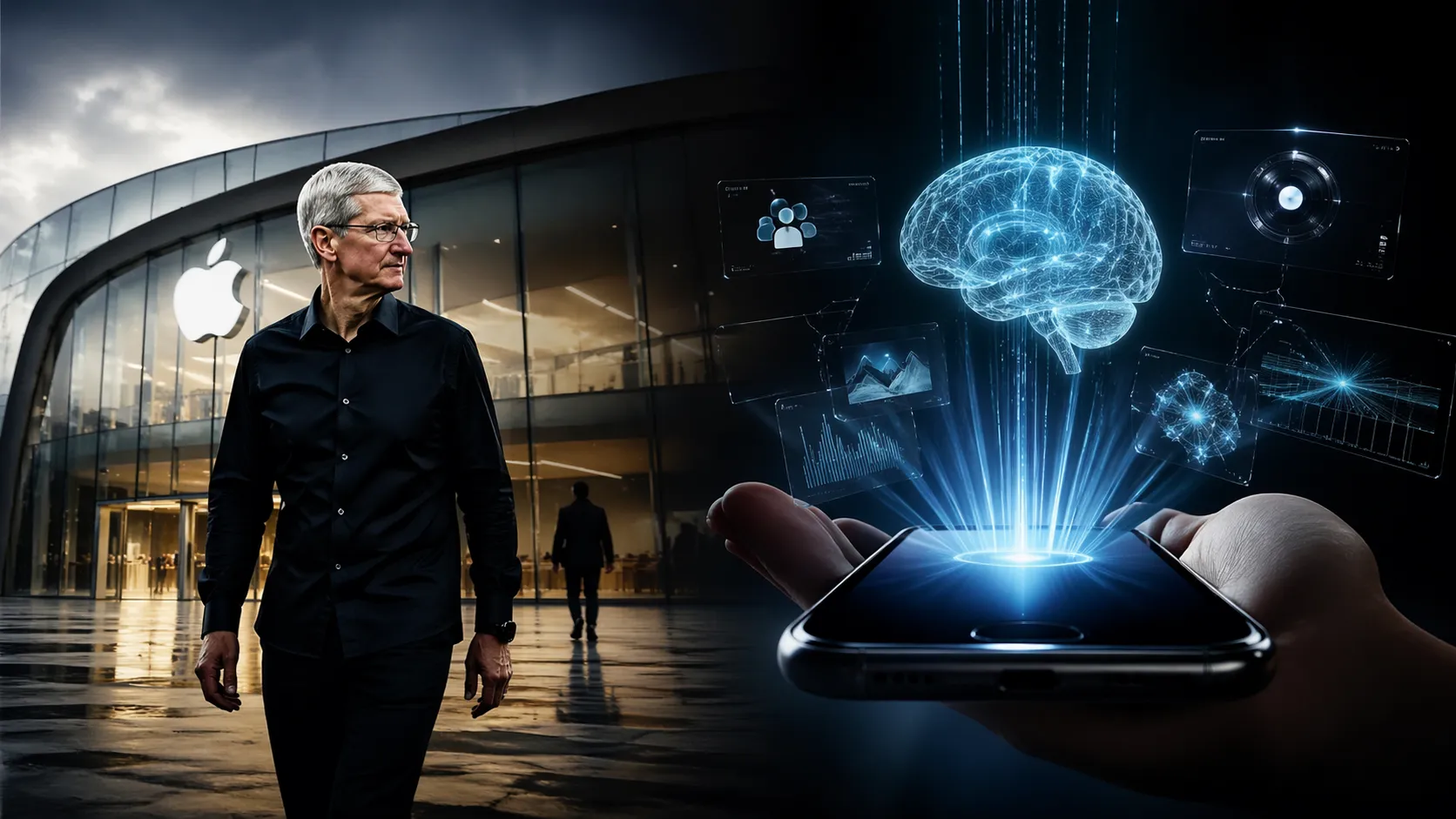
Apple CEO Tim Cook will step down in 2026, marking a pivotal moment for the company’s AI strategy. After fifteen years at the helm, Cook hands the reins to hardware chief John Ternus. The real question: what does this mean for Apple’s standing in the global AI race?
Why Tim Cook is leaving—and what he leaves behind
Cook’s exit isn’t a shock, but the timing is sensitive. Apple is in the middle of a strategic reset around artificial intelligence.
Since 2011, Cook turned Apple into a $4 trillion tech powerhouse. Under his leadership:
- revenue surged past $400 billion
- the iPhone became Apple’s dominant product
- services grew into a multi-billion-dollar business
At the same time, Apple lagged in generative AI, where rivals like Microsoft and Google moved faster.
Cook himself acknowledged AI is “bigger than the internet and smartphones,” yet Apple deliberately chose a slower, privacy-led path.
What changes with new CEO John Ternus?
Appointing John Ternus signals continuity, not a radical pivot.
Ternus is a hardware heavyweight who played a key role in:
- iPhone development
- Apple Silicon chips
- the new Mac architecture
Analysts expect Apple under Ternus to weave AI into existing products rather than build entirely new AI-first platforms.
In practice, that means:
- deep AI integration across iPhone, Mac, and wearables
- a continued focus on the ecosystem, not standalone AI tools
- less emphasis on splashy AI launches like ChatGPT
Apple’s AI strategy: falling behind—or playing it smart?
Apple trails in generative AI, but partly by design. The company is taking a different tack than its competitors.
1. Privacy-first AI
Apple runs as much AI as possible on the device itself (on-device AI). That means:
- less data sent to the cloud
- more user control
- stronger privacy protections
Cook positioned privacy as a competitive edge.
2. Integration across the ecosystem
Instead of standalone AI products, Apple bakes AI into existing services like:
- Siri (with upgrades using, among others, Gemini technology)
- iOS and macOS
- Apple Intelligence
3. Partnerships and a catch-up push
Apple is now partnering with Google for AI models.
It’s a pragmatic choice: integrate first, build everything in-house later—if needed.
The biggest challenge: speeding up AI innovation
Speed is Apple’s critical challenge. AI is moving at breakneck pace, and Apple must accelerate to stay relevant.
Key pain points:
- AI development trails the competition
- Siri is seen as outdated
- fewer visible, headline AI products
Analysts warn Apple needs to revamp its AI strategy to stay competitive.
What does this mean for the future?
1. No sudden AI revolution at Apple
Don’t expect radical, OpenAI- or Google-style AI products.
Instead, expect:
- steady, iterative improvements
- AI as an invisible layer in products
- a relentless focus on user experience
2. Hardware will matter more in AI
Choosing a hardware-focused CEO is strategic. AI isn’t just software—it’s chips and devices.
This matches a broader trend: cutting-edge AI demands specialized hardware.
3. The ecosystem remains Apple’s ace
Apple’s power is in integration:
- iPhone + Mac + services + AI
- a tightly controlled ecosystem
- a loyal user base
That can help Apple scale AI—even without owning the most advanced models.
Conclusion: evolution, not revolution
Tim Cook’s exit doesn’t herald a sharp turn—but it does signal an acceleration of Apple’s existing playbook.
Apple is opting for:
- controlled AI integration
- a focus on hardware and ecosystems
- privacy as a defining feature
The real question isn’t whether Apple takes AI seriously—it’s whether it can move fast enough.
The next few years under John Ternus will show whether Apple can turn its lag into an advantage.


Loading